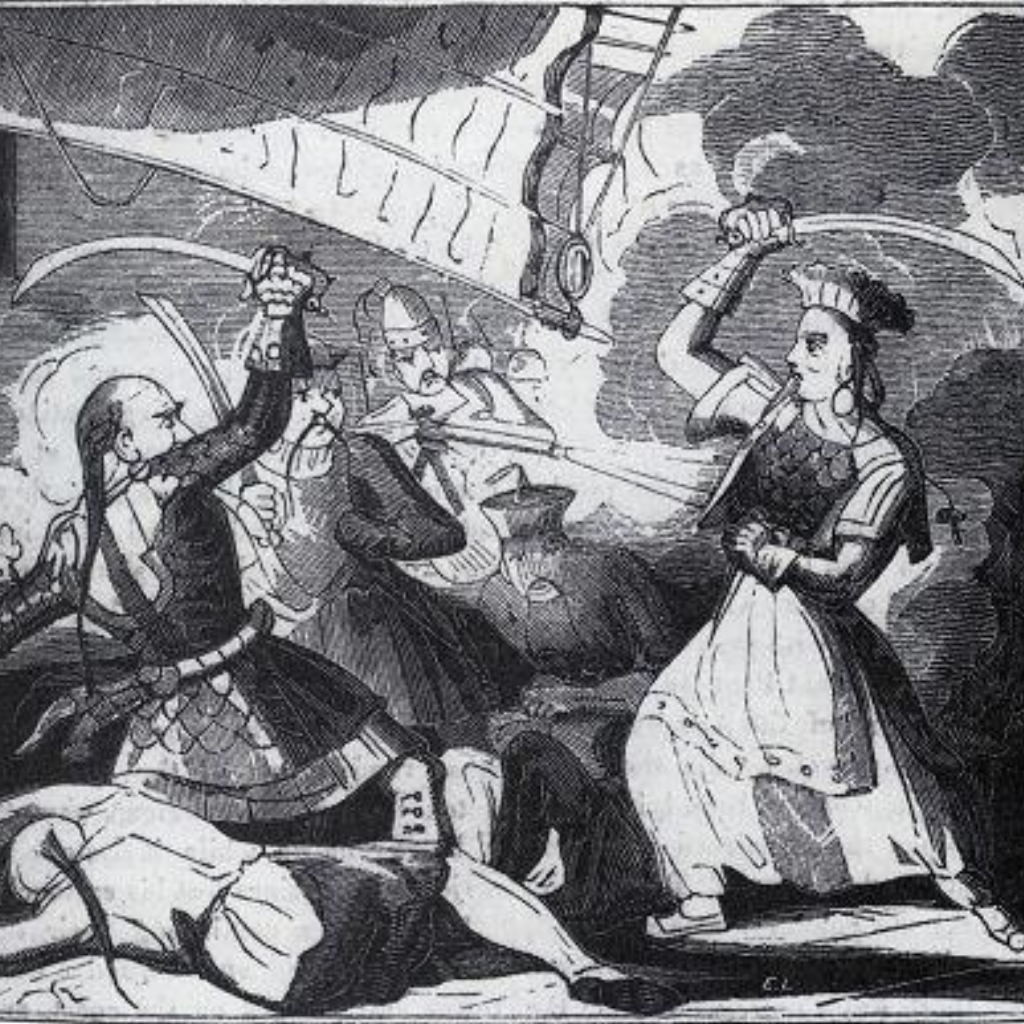
Zheng Yi Sao was a successful Chinese pirate leader who commanded one of the largest pirate fleets in history. At its peak, it is thought to have been made up of 400 ships and up to 70,000 pirates.
Before we go any further it is important to mention that despite her huge success and fame there is surprisingly little confirmed for definite information about her so we need to bear in mind that a lot of what we do know will almost certainly be a mixture of reality, myth and legend. It’s for this reason I’ll be taking a deep dive into how the pirates formed in the south China sea and more of the context around it as well- otherwise this blog would be like 300 words.
So, Zheng herself was born as Shi Yang in either 1775 or 1776 CE and there are some theories out there that she was actually sold by her family which happened more than you’d think when families struggled to make ends meet, they would often sell a child. Before we get into more of her story, I thought it would be useful and above all else interesting to go into more of the background about what was happening at the time.
Pirates in the South China sea
The south China sea at this time had a large sea-based community with many of them being fishermen. There wasn’t much land that would make good farms, hence why so many people reverted to fishing. The fishing season lasted half of the year and the other half of the year many of the fisherman would resort to piracy.
Now this wasn’t piracy that your minds almost certainly went to, we’re not talking Blackbeard here. These acts of piracy would have been on a much smaller scale. Raiding areas on the coast and attacking local business boats or if they felt riskier taking on some of the foreign trade ships. These raids would only consist of a handful of people at anyone time so a small-scale level of piracy.
Because the piracy was so small scale, it would perhaps be best described as a “local nuisance”. Whereas the fearsome legendary pirates – I still find it so strange that we called pirates legendary given how cruel they had a habit of being- the smaller scale level raiders could quite comfortably return home and not have an eyebrow raised at them.
In the 1770s there was a rebellion in Vietnam. This saw peasant rebellions led by three brothers- perhaps something we’ll revisit in a future Not-So-Romantic blog. The conclusion of the story was that the rebellion was successful, and a new emperor was installed from the rebel’s side. This united Vietnam for the first time in a very long time.
Obviously, the surviving members of the overthrown weren’t very happy so were constantly challenging and hustling – I feel like that’s the wrong term, but let’s go with it- to get back into power.
The new rulers of Vietnam didn’t have a navy, leaving them a little exposed. To counter this, they sent recruiters along the coast to China to recruit these fisherman pirates – cool book name? – as privateers. A privateer were technically pirates, but they had government permission to do it.
These fisherman pirates now had a base in Vietnam and were previously they may have been operating in groups of 10 or 11 they were now starting to operate in groups of maybe 100s- heck of an upscale in the workforce. All the smaller parties came together and formed a confederacy.
A confederacy is an alliance of sorts. A loose alliance I suppose. It was a partnership of separate partners who all agreed to cooperate for shared goals whilst keeping most of their own power. It was a way of being on the same page without having whilst still having your own individual pages- weird sentence but hopefully it makes sense.
They started to learn how to work together and become a more dangerous unit as one rather than operating completely alone.
In the early 1800s the new emperors were overthrown in Vietnam and the pirate fisherman or privateers as we should now call them lost their base in the country and were forced to return to China. Unlike the smaller ships that left, however, they are now bigger with there being 6 or 7 more prominent fleets.
You’ve probably already guessed but they all started to fight each other. The fighting lasts a few years until they came to the realisation that fighting each other wasn’t benefitting anyone. For that reason, they came together and actually created a contract.
In this contract they divided up the area that each of the prominent fleets were in control of and could operate within. Each fleet ship was to fly the flag of the fleet they were part of and rules were created about how treasure was divided up and distributed. They even set up a central pot for some profits to be put into which was used to support those who weren’t maybe doing as well.
All this was the start of large-scale piracy off the coast of China. Previously most of the threats to China hadn’t come from the south sea. They’d come from the land in the northwest which was where all the resources were and because of other smaller rebellions happening at the time in the north, the Chinese government weren’t able to provide the resources needed to deal with the ever-growing threat of the pirates. Not being able to put down the threat before it really got going would prove to be a fairly serious problem.
A town called Jiang Ping on the border of China and Vietnam was mostly known for being a fishing market, but it slowly became a recruitment hub as it was where pirate captains would go to replenish the troops.
The red flag fleet and rise to power
Zheng’s journey into piracy starts when she was linked up with a man who would become her husband- Zheng Yi. He had been one of the privateers who had supported the rebellion emperor in Vietnam. He rose to a high position in what was known as the “red flag fleet”.
We don’t know for sure that they were married in the traditional sense. There were some practices enforced that if a woman was captured and held for ransom, some of them could be purchased by the pirates. Ultimately, we really don’t know.
Could it have been a love born from the sea?
At either rate, when her husband died. It was Zheng Yi Sao who took over control of the red fleet. We’re not sure how she was able to take control of a very male dominated world and environment, but she got support. A lot of fleets had family connections a bit like a monarchy would, so she could have won over family support, been the lesser of two evils rather than another family member taking over or simply the best candidate to take control of the red fleet. Like so much, we simply just will never know. What we do know, is she was able to succeed over any rival fractions who were against her.
The red flag fleet was said to have been the largest collection of sailors when the Vietnamese rebel emperor was overthrown. Because it appears to have operated between the pearl River Delta- Hong Kong and Macau today- it was allowed and had space to maintain its size and grow. It would have been the richest area because of increasing global trade in that area.
Western powers weren’t allowed bases or docks in China so they would participate in something known as the ‘Canton system’. To keep it simple it was a system that only allowed Western sea trade to pass through one port only in Canton. It was how the Chinese kept tight control over foreign influence from the outside world. That was a lot of ship to raid and take goods from for the red fleet. There was the local trade to take advantage of as well.
The red flag fleet were comfortably able to decimate the imperial water forces should they ever come calling. There were stories that imperial sailors were so afraid to leave the port and would actually damage their own vessels to make them leak just to get out of having to go and face the red flag fleet and the confederation they were part of.
It’s clear the pirates were in control.
Taking care of the salt
I promise I’m going to actually talk about Zheng Yi Sao- it is difficult as we don’t have the most details about her- but just to quickly share another piece of evidence which shows just how in control the pirates were.
Three or four times a year, salt was harvested from where is called the Leijo Peninsula. The salt would be harvested and then shipped Guangzhou for distribution around China. The pirates very quickly captured the transporting fleets or at least had them under control which led to them actually being paid to escort the salt ships to Guangzhou.
They really couldn’t be touched.
They even started selling documents that would allow safe passage through the South China sea. If you had one of these documents and were still attacked, the attackers had to reimburse you. They charged local sea villages for protection as well. If you didn’t want to be attacked you had to pay up.
Zheng Yi Sao
What we do know is that when she gave an order it was followed. This requires a lot of respect. After the death of her husband, she not only ruled the red fleet but the confederacy as a whole.
She negotiated alliances between rival pirate groups strongly maintained the pirate code and her forces were able to avoid the Quing (government equivilant) navy, British ships and Portuguese fleets due to her military brain.
She wrote a strong pirate code, which was fiercely enforced.
- If any pirate goes privately on shore, he shall be taken, his ears mutilated and then paraded around the fleet and executed.
- All stolen and plundered goods shall be registered. Out of 10 parts, 2 will go to the individual, 8 parts go to the general fund. If anyone steal s from the general fund, they will be executed.
- Women captured from villages shall not be harmed or harassed. They shall be registered with their place of origin and given separate quarters. Any crimes against women captives shall be punished by execution.
She certainly laid down the law as she ran the confederacy alongside Zhang Bao who had been Zheng Yis adopted son- Bao would later become her husband.
There is a reason I haven’t said “the most successful women pirate” and that’s because there is a strong argument, she was the most successful pirate ever. Way bigger than the pirates from the west- even Blackbeard, who may be the most famous pirate but only had a handful of ships and several hundred men at most during his peak.
She didn’t do it alone but to command and stay in command of that many people, in an age dominated by men? That’s, to put it very mildly, impressive.
To add the final point to just how in control she was, in around 1810 when the confederacy became no more, it was Zheng Yi Sao that bought it to and end by negotiating a surrender with the government.
Some people may look at this as a sign of weakness, but I think it’s a sign of knowing when to quit and which battles are worth fighting.
Retirement planning
The government started to put more and more pressure on the pirates. The black flag fleet actually surrendered to the government forces and became pirate hunters instead. Along with the red flag fleet the black flag fleet was amongst the largest in the confederacy and them turning tailcoat and becoming hunters, presented a big problem for the remaining fleets in the confederacy.
A new general had been sent down to quell the pirate threat, and he made it more difficult for the pirates to get food in particular.
If you have ever looked into any pirates before you will probably know that pirates didn’t really get to retire. Their retirement was normally bought forward by death. That wasn’t the case for the confederacy thanks to Zheng Yi Sao and her negotiation skills.
The surrender saw the leaders of the confederacy got commissions in the government. Zhang Bao was actually allowed to keep a good amount of his ships to become part of the salt trade, and he rose swiftly through the military ranks.
Zheng Yi Sao found a different retirement plan and lived off the proceeds of a gambling house she opened. So, the surrender enabled them to live the rest of their lives with relative success.
Legacy
Pirates in China weren’t romanticized – that’s the word I was looking for earlier- in literature or the history of China. There were some huge pirate moments but because they weren’t romanticized, they didn’t have any sort of huge legacy.
Zheng’s fame has pretty much exclusively come from Western scholars. The episode of the piracy in the South China sea was told by government individuals more as a warning to not let it happen again, but these stories were translated and shipped to an English readership.
We might not know as much as we would like to know but Zheng Yi Sao commanded the largest fleet of ships and pirates around the world and kept them all at peace and even managed to negotiate a successful surrender which saw the improvement of many former pirates’ lives.
She has come more to light in more recent times but there’s still hopefully much more we can discover and the early 1900s writers certainly threw a lot of legend into her story.
Zheng passed away in 1844 at almost 70 years old.
What to read next
Thank you for taking the time to read this Not-So-Romantic blog. There are millions if not billions of other blogs out there so a sincere thank you for giving this one a read.
Below you’ll find a blog along a similar topic.