
What if I was in charge of fixing global warming? Not a question I’ve often wondered to myself, but I’m going to answer it today as in this Not-So-Romantic blog I’m putting myself in charge of fixing global warming- I will acknowledge that I called the blog that because it sounded a better title. I honestly don’t think global warming can be fixed but, like all risks out there, the effects can be reduced.
It feels strange that it’s almost controversial to say that “I believe global warming is real”. There will always be people who disagree and that’s okay because we are all allowed different opinions but, in my mind at least global warming is real and is too dangerous to be ignored.
I’m giving myself a blank cheque which is often the main criticism of green energy is how expensive the infrastructure is to build. And it is a somewhat valid point with some offshore wind turbines and their foundations to stand in the ocean costing up to 25 million pounds each.
Infrastructure might be expensive, but to help the planet and leave the Earth in a better condition for future generations surely make that expense worth it? (let me know your thoughts in the comments below)
Before we go any further, you’re probably wondering how this theme fits into being “Not-So-Romantic”. My reasoning as to why this topic fits on the Not-So-Romantic blog is that the results of not doing anything about global warming aren’t very Not-So-Romantic. You don’t have to accept my reasoning, but it’s what I’m going with because I fancied giving myself unlimited power.
Jargon busting
There is a lot of jargon involved when it comes to this global warming stuff so before we go any further let’s break it down so we can all move forward with more confidence that we know what these jargon words mean.
- Climate change: long-term changes in Earth’s climate patterns
- Greenhouse gasses: Gases that trap heat in the Earth’s atmosphere acting a little bit like the glass of a greenhouse. These gasses include carbon dioxide, methane, nitrous oxide and fluorinated gases from things like air conditioning.
- Greenhouse effect: The process by which gases in the atmosphere trap heat
- Anthropogenic: Caused by human activity
- Carbon footprint: The total greenhouse gas emissions caused by a person, organisation or activity.
- Emissions: Release of greenhouse gases into the atmosphere
What is global warming
So, onto the big question you may have. What is global warming?
Put simply, global warming is the rise in Earth’s average temperature, mainly due to human activities. If you imagine the Earth is a person sleeping under a blanket. The blanket will keep the person warm and comfortable. Now let’s say that our version of burning non-renewable fuel is our nightly farts whilst we’re wrapped in our warm and comfortable blanket. The farts have no way to escape so they add layers onto our blanket making us hotter and eventually less comfortable.
That’s exactly what is happening to the Earth. The planet has a blanket around it and we’re making that blanket thicker which is making the planet warmer and less comfortable for many habitants of the place we call home.
The main effects of global warming are:
- Hotter temperatures
- More heatwaves
- Melting ice caps
- Rising sea levels
- More extreme weather such as floods and droughts
All the above have adverse effects on the environment and wildlife
I do want to say before we get into my suggestions of how “I’d fix” global warming that I don’t believe just switching off all the coal and gas plants in one foul swoop is the solution, because we have a great need to create new infrastructure, I believe a slow approach is needed where you tip the scales from non-renewable to renewable sources. We can’t take too long to make the switch, but we still need a lot of infrastructure building, and we do need to speed that up if we’re going to blunt the tip of global warming.
In the UK currently we generate electricity in several ways. In 2025, this is where the power in the UK was generated.
- 29.7%- Wind power
- 26.8%- Natural gas
- 11.8%- Nuclear power
- 15.1% Imported
- 6.9%- Biomass (Burning waste and wood pellets)
- 6.5%- Solar
- 1.6%- Hydro
- 1.6% storage
This means that 15.1% of electricity is ported in from other countries which I personally think is crazy. Obviously necessary with the current infrastructure but it just seems a completely missed opportunity to not be self-efficient. In the real world that would require a lot of investment, but surely, it’s worth it?
The UK can’t currently store surplus electricity – like that generated on a windier day- and infrastructure like high-voltage transmission lines aren’t in place.
Anyway, I’m not here to write about how we currently generate our electricity- that was meant to just be for general information and not kick start a ramble- I will just quickly mention that money is being invested into beefing up the infrastructure, so it’s not all doom and gloom. We’re here to talk about global warming and how I’d fix it if I was charged with that responsibility.
Before we get to that thought, I of course, would love to hear your suggestions in the comments below!
Okay, how would I “fix” global warming?
Greywater plumbing system
Question of the day: Why do we need fresh water to flush our poop away?
Answer: You don’t.
My first suggestion for how we can make small but effective changes to help fix global warming are greywater plumbing systems.
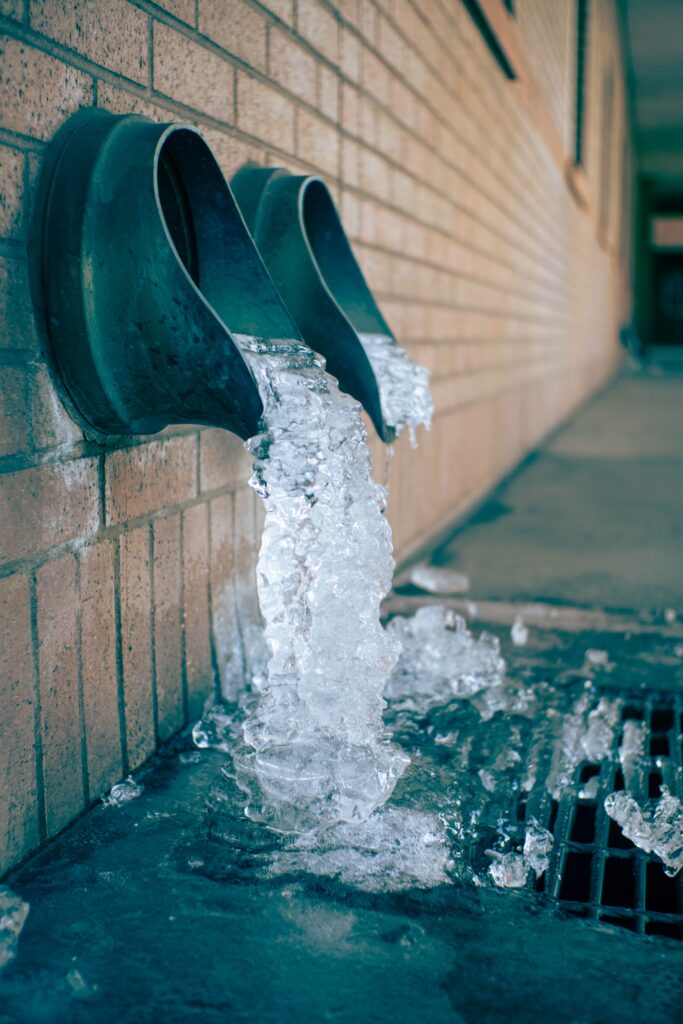
Toilet flushing accounts for a substantial proportion of indoor water use, which is why I think it makes sense to use a greywater system. This change can save a surprising amount.
An average toilet flush uses 4-6 litres of water with the average person flushing the toilet 4-5 times a day. That’s up to 30 litres of water used a day by just flushing the toilet for someone living on their own- that’s about 10,900 litres of water a year just flushing the toilet.
A greywater plumbing system collects lightly used water from sources like bathroom sinks, showers, baths and sometimes washing machines, then reuses it for non-drinking purposes.
If you took greywater from your bathroom sink and shower you could produce 80-100 litres of greywater per day and save roughly 15,000 litres of mains water per year.
And forget the environmental benefits for a few moments, you could save up to £75 a year using greywater- I know that doesn’t sound a lot but that’s still £75 (£6 a month) back in your pocket.
I think I’m going to need to find better financial savings than that to convert anyone by dangling money back in your pocket in your face.
So, how about the environmental impacts?
The most obvious one is the reduction in drinking water consumption. Normally, toilets are flushed with fully treated drinking-quality water – yep, you could stick your head in the toilet and drink that water- by using greywater which has already been used for washing hands or showering it means that less fresh water has to be taken from rivers and reservoirs.
It reduces energy use, less water needed for extracting water, less water needing treating, less water being pumped through the network and less wastewater to treat afterwards. You’re using your water twice rather than once.
Greywater can massively help during droughts (though water companies need to be and should be forced into doing more to build reservoirs and more advanced water systems- it rains more than enough in winter for us to have enough water if the infrastructure was better maintained and developed). Despite my mini rant there, using greywater can reduce the demand on household water demand and by extension reduce the strain on water infrastructure.
There are some cons with the greywater system. They aren’t always ‘green’ as the require pumps, uses chemical treatments (soap and shampoo would destroy your toilet from the inside), would need a large storage tank and does need some maintenance.
But if done on a large scale the benefits do pros do outweigh the cons.
So, what is my proposal? I say that every house should make use of a greywater system for flushing toilets. If every house in the UK used this system, we could potentially prevent 250,000 tonnes of carbon dioxide going into the atmosphere every year.
A streamlined and perhaps more realistic proposal would be that office buildings and other public buildings have the system installed.
Poo power
Yep, poo power and I’m very excited about it.
We all know that every person on the planet poos at least once a day- no matter what they tell you. What I’m suggesting is that we take everybody’s poo (we will probably need a better way of collecting it, we couldn’t do what we do for our regular bin collections) and turn it into biogas.
This is done in a couple of ways.
The first is by putting the poo in huge containers and let microorganisms break it all down to turn it into biogas in its gas state which is then sucked out of the containers and burnt in generators.
The second way is to dry out the waste products and squash them down into solid biogas briquettes- these large blocks can then be burnt like coal or wood.
It sounds gross on the surface when you just think of the title. But, we’re not fully taking advantage of one of our most renewable sources of energy. We’re- hopefully- not going to stop pooing! We can throw animal poo in there for good measure as well.
Some of you may be wondering if this actually helps with global warming and I’m glad to say it does. The methane that would normally be released from burning biogas is captured and either pumped into heating systems in the biogas generators themselves or it’s completely broken down to massively reduce the global warming effect.
This whole process from start to finish is known as Anaerobic Digestion. And rather than explaining how it works in lots of detail, here’s a diagram that explains it far better than I ever would.
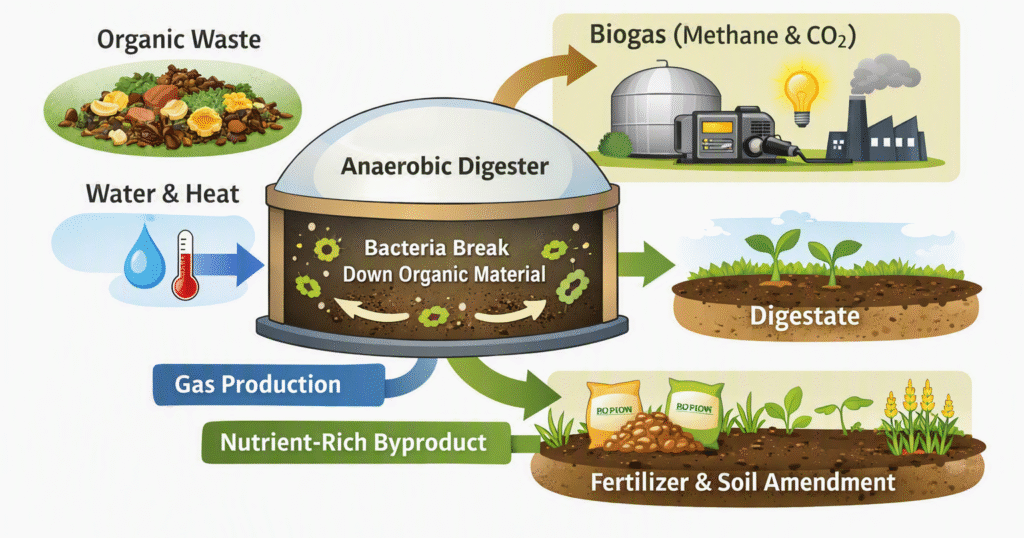
So we’re on the same page because I was a little confused as well- Digestate is the stuff that’s left over from the process.
Poo is basically an infinite fuel supply that we need to be taking advantage of.
Collect rainwater from gutters
This is something I’ve wanted to do in my own house for a long time, but up until recently I’ve always rented but not I own my property so will finally be able to do this.
Collecting rainwater from gutters just makes so much sense to me and I don’t understand why more people don’t do it. Collecting rainwater, even just to use for watering household plants has many of the effects as the above point of greywater systems- minus the fact that it requires a lot of maintaining once it’s set up.
I suppose you don’t even need to add the water butt to a gutter; you can just have one in your garden somewhere collecting rainwater.
How much water you could save would all depend on how big your water butt was. If it’s 100 litres than you save 100 litres when it’s full. If you’re watering your plants regularly you will save more as your using water and then letting it be topped up again.
Even if this water is used to top up the bird bath now and again it’s worth doing as it’s a little less water coming from the system and -if you are refilling the bird bath- it helps the ecosystem as well.
The more gutters water is collected from the more effective this proposal will be. If 10 houses store 100 litres of water, that’s 1000 litres of water that isn’t coming out the system. At the time of writing there are 30.4 million houses In the UK- if each of them saved a minimum of 100 litres a year- and let’s face it, it’d be easy to save more- then that would be three billion litres saved each year. That’s enough water to fill 1,216 Olympic-sized swimming pools, satisfy 608 million toilet flushes and fill 38 million standard baths- not that I have any idea what a standard sized bath is. Do you?
That’s a lot of water and has cheap start up costs. All from just collecting 100 litres minimum of rainwater.
Solar panels on all new builds and public buildings
I actually think the first part of this proposal is already being done. All new builds should get solar panels on the roof, and they should be added to all public buildings. This speaks for itself really.
Solar panels are already well used around the globe. You’ll see them on roofs of houses, as larger solar farms- set up on big open areas to pump electricity into the electricity grid- and, of course, on some of our favourite garden ornaments.
Solar is the fastest growing energy source with 9.5% (give and take) of the world’s electricity is generated by solar which is considerably more than the 3% generated in 2020 and 1% in 2015. Here in the UK, 6.5% of electricity is generated using solar panels.
You put solar panels on the roof to put some electricity back into the system or just power the toilet lights or even charge batteries for emergency use. It will all add to reducing those expensive electricity bills and if you’re a factory owner can reduce operating costs as well.
Under my proposals solar panels would be a requirement for all new build houses and any access electric to be either stored or used to power parts of the house. With the roof space available in the UK, I’d make sure we added enough solar panels to offset the reduce the amount of electricity imported we needed to do.
Plus, the sun isn’t supposed to disappear for at least 5 billion years so it’s not like we’re going to run out of sunlight anytime soon and I hope in 5 billion years we’d be have developed even more ways of producing green energy.
Did you know? The first working solar cell (one of the sections that make up a solar panel) was actually invented all the way back in 1882. It wasn’t very good, but it was still there in its basic form!
Trees in the sea
Time for one of those “crazy and out of the box ideas” which, being completely honest, are normally my favourite ideas.
This proposal would be planting trees on a small floating platform and anchoring them in sea. Scientists reckon we need to plant an additional 1 trillion trees on top of the 3 trillion trees we already have- it does also say they need to be in suitable locations which probably isn’t the ocean but let’s ignore that for a second- where are we going to put them all? Where are we going to put all the new trees?
I suggest we replace all buoys with trees. Not only will it look prettier in the middle of the ocean, but it will also absorb some carbon. Imagine instead of casting out to see a hundred orange buoys when you’re stood on the end of a romantic pier near the coast you see one hundred trees instead.
Much better right? And plus, if you get the right trees, it will provide shelter and rest for birds which helps boost the ecosystem as well.
Just a note of explanation on “suitable locations”, putting a tree in the middle of ocean wouldn’t be the most “suitable location” as it wouldn’t be near huge build ups of carbon dioxide. The best effects may come from this idea by planting small forests of cruise ships to off sync the travellers carbon dioxide and the carbon footprint of the cruise itself.
Put trees in the sea, what could be simpler?
Artificial trees – trees that mimic photosynthesis but work faster- might be the solution for my trees in the ocean.
Seaweed cities
Sounds a little strange right? A city made of seaweed. I promise it’s not what you’re instantly imagining.
Seaweed grows by using sunlight and carbon dioxide- just like plants on land- so by making floating platforms in the ocean means people could harvest the seaweed to make food, fuel and some other useful products- seaweed can be turning into food wrappers, drinking straws and biodegradable packaging. It’s even turned into face creams and wound dressings.
Seaweed is useful way beyond food! Building ocean farms of seaweed would help the planet and people. A literal win-win.

Underground forests
Normally trees store carbon in the trunk, branches and leaves but as we see in lots of warm summers, trees can burn down, be cut down, rot and die from disease which means the carbon is released. Underground forests would be my answer to this by taking advantage of roots- yeah, I was being slightly misleading, I didn’t mean a literal forest.
Plants which grow long roots can store carbon underground in the soil- where it stays for a long time. My plan would be to grow crops and grasses with bigger, deeper roots. These plants would still provide food and look normal above ground, but underground would be a forest of deep roots which would help lock away carbon and slow climate change.
It wouldn’t affect the food supply and every year more plants with- hopefully- even longer roots will continue pumping the carbon into the soil. Some of it would escape when the plants were harvested but the roots would be left behind along with the majority of the carbon.
Storage upgrades
Just like how some days are rainier than others, some days are also windier than others. On those days, more electricity can be generated on wind farms. We need to be able to store that power more effectively so we can call upon it when we need it. By storing more excess energy it means we wouldn’t have to import it which costs time, money and has global warming effects to transport it from A to B.
Get a better and more effective storage system and not only does it make us less reliant on imports and – hopefully- provide cheaper bills but also has a positive effect on global warming- will be useful to have more power stored in case of a zombie apocalypse as well.
Regenerative braking on all trains and electric vehicles
Again, this is something that is mostly already done so this proposal is more about making sure that it’s applied to all trains on the network and that is “regenerative breaking”. I could give you a really long winded and quick honestly boring explanation of what regenerative braking is and how it works.
All we really need to know is that when the train buts on its breaks, the wheel stops taking power from the grid and the movement of the wheel is used to produce electricity to go back into the electric grid.
Electric and hybrid cars have this feature as well which means slightly less power needed for charging at the end of the day.
When you use regenerative breaking you capture energy that would normally be turned into wasted heat and it takes some stress on physical parts of the trains/cars meaning less wear and tear on them.
I’ve always thought that small changes and tweaks can make huge long-term differences. Regenerative braking is one of those small tweaks. So, if I was in charge of “fixing” global warming- I would make sure that all trains had regenerative breaking and whilst I was at it, I’d make sure that
Potato power
Yep, you read the heading correctly. I propose to use potato power. Have you ever seen a potato clock? You plug some nails into a potato, hook up some wires and you have yourself a fully operational clock.

Why don’t we scale this up?
Each potato can generate approximately 0.5 volts of electricity; there is research that suggests if you boil a potato first it will generate 10x that (so 5 volts). You’d need 30,000 raw potatoes if you wanted to fully charge your smartphone. That’s doable right?
You’ve probably already guessed that this proposal is more a joke than a serious suggestion. It would be an interesting thought though, we won’t run out of potatoes if we keep planting them so maybe they could be used for something that needs a little less power?
What do you think?
I would say that these suggestions are 50/50 when it comes to be realistic or fully serious or not. Either way, this was a fun thought exercise.
In summary, I would ‘fix’ global warming by:
- Installing greywater systems in houses
- Planting trees in the sea as buoys replacement
- Collect rainwater from gutters
- Hybrid vehicles
- Solar panels on all new builds and public buildings
Thank you so much for reading this far, there’s so much content online in today’s world so by taking the time to read this little blog on the internet means a whole lot to me. If you have enjoyed this blog, then please consider leaving a comment below about how you would “fix” global warming or even just your favourite suggestion in the blog. You could even just say hello.
Here are some other blogs I think you would also enjoy if you wanted to keep exploring the Not-So-Romantic blog.